Madrid is famous for being a city of concrete, horns, and sweltering summers. What is not always mentioned is that, amidst so much pavement and so many buildings, the capital conceals a network of green spaces that surprises even those who have lived here for years. From large natural lungs that rival the best parks in Europe to almost secret romantic gardens that open only on weekends, the most beautiful parks in Madrid are much more than one would expect to find in a large metropolis. This guide reviews the most notable, the most curious, and those that should not be missed on any list of outdoor plans in the city.
Retiro, the Inevitable Reference
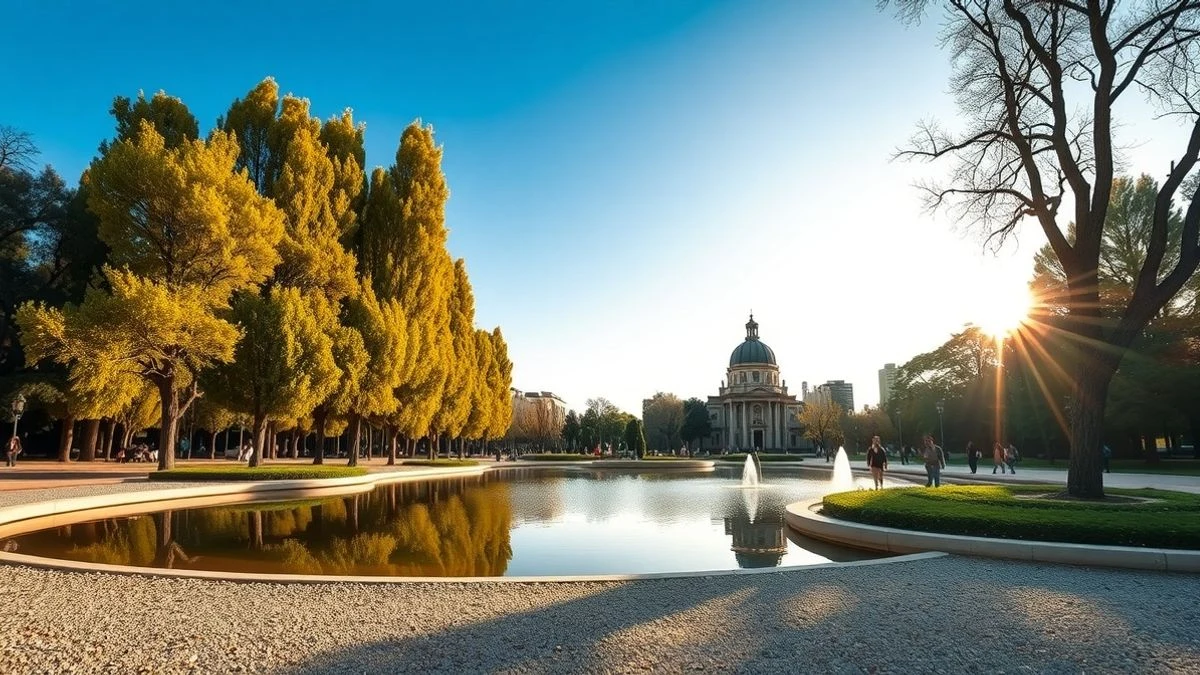
No list of the most beautiful parks in Madrid is complete without starting with the Parque del Buen Retiro. With 118 hectares in the heart of the city, this green space is at once a museum, an improvised concert hall, a jogging track, and a meeting point for generations. Built in the 17th century as a private garden for the court of Philip IV, it gradually opened its doors to the public until it became what it is today: a place where retirees read the newspaper, families row on the Estanque Grande, tourists photograph the Crystal Palace, and groups of friends lie on the grass.
Beyond the usual stroll, Retiro holds corners that many frequent visitors have yet to discover. The Cecilio Rodríguez Gardens, for example, are a haven complete with peacocks. The Rose Garden, between May and June, is a spectacle of colour and scent that merits a visit on its own. And the Crystal Palace, home to the Reina Sofía Museum, hosts free exhibitions in a 1887 iron and glass building that seems to be from another century. The Fountain of the Fallen Angel, one of the few sculptures in the world dedicated to Lucifer, adds a charming touch of rarity to the ensemble.
Casa de Campo: The Forest Within the City
If Retiro is the most well-known park, Casa de Campo is the largest. With over 1,500 hectares, it is one of the largest urban parks in all of Europe, and walking through its inner paths completely makes one forget that they are in a capital city of nearly four million inhabitants. Once a hunting ground for the monarchy, today it is a protected natural space where hiking, cycling, birdwatching, and the simple pleasure of sitting by the lake to eat something coexist.
Inside, you will also find the Amusement Park and the Zoo Aquarium, making it a complete family option. The cable car that connects Casa de Campo with the Parque del Oeste adds a literal viewpoint over the city that very few people take advantage of.
Madrid Río and Parque del Oeste: The City by the Water
Madrid Río is perhaps the most successful urban project in the capital in recent decades. This linear park was born from burying the M-30 ring road underground and returning the banks of the Manzanares River to the citizens. The result is a green corridor of several kilometres with bike lanes, innovative children's areas, interactive fountains, viewpoints, and sports spaces that connect neighbourhoods that previously turned their backs on the river. The Arganzuela Bridge, with its spiral design, has become one of the photographic icons of the new Madrid.
A few kilometres further up, Parque del Oeste combines history and nature in a way that is hard to find elsewhere. Its Ramón Ortiz Rose Garden, covering more than 15,000 square metres, has hosted the International New Roses Competition of Madrid every year since 1956. And at its westernmost end stands the Temple of Debod, an Egyptian temple over 2,200 years old donated by Egypt to Spain, which offers one of the most photogenic views of the entire city at sunset.
Gardens with History: Campo del Moro, Sabatini, and Finca de Vista Alegre
Next to the Royal Palace are two of the most elegant and least crowded gardens in Madrid. The Campo del Moro Gardens, named after the Muslim leader Alí Ben Yusuf and with a somewhat hidden access, feature a Victorian-style layout with ornamental fountains, centenary trees, and peacocks that stroll with an air of dignity uncharacteristic of a public park. From here, one can enjoy one of the best views of the rear facade of the Royal Palace, especially early in the morning.
The Sabatini Gardens, to the north of the Palace, provide a geometric and neoclassical counterpoint: perfectly symmetrical flowerbeds, sculptures of Hispanic kings, and a central fountain that becomes the stage for the Veranos de la Villa in summer. Access is free and open, offering a completely different perspective of the Royal Palace.
Further south, in the Carabanchel neighbourhood, the Finca de Vista Alegre is one of those discoveries that surprises even lifelong Madrilenians. It was a leisure spot for kings and nobles in the 19th century, and its romantic, geometric gardens with exotic plants only opened to the public in 2021. It is classified as a Cultural Heritage Site in the Historic Garden category, giving it a cultural weight that few green spaces in the city can match.
More Discreet Gems: El Capricho, Quinta de los Molinos, and Dehesa de la Villa
The El Capricho Garden, in the Alameda de Osuna, is probably the most beautiful and least known garden in Madrid. Designed by the Duchess of Osuna in the late 18th century, it blends French, English, and Italian influences in a setting that includes a plant labyrinth, artificial lakes, mythological sculptures, a hermitage, and, as an unusual detail, a Civil War bunker accessible via guided tours. It opens only on weekends and holidays, with limited capacity, which gives it an air of exclusivity that contrasts with its completely free access.
The Quinta de los Molinos, in the San Blas neighbourhood, has its moment of glory between February and March when its almond trees bloom, transforming the park into a cloud of white and pink flowers reminiscent of Japanese cherry blossoms. The rest of the year, it is a quiet and family-friendly place, with dirt paths, a lake, centenary olive trees, and stately architecture that has granted it the status of Historic Park since 1997.
The Dehesa de la Villa, on the other hand, is more of a forest than a garden. Its 700,000 square metres of pines, almond trees, poplars, and ashes in the northwest of the city serve as a lung for the neighbourhood and a meeting point for hikers and runners. More than 70 different species of birds have been spotted here, and from its viewpoints, one can enjoy panoramic views of Madrid that very few know about.
Parks for Sports and Families
The Enrique Tierno Galván Park, in the south of the city, is a favourite among many Madrid families for a simple reason: it combines 45 hectares of meadows and ponds with the Madrid Planetarium and an outdoor auditorium. The picnic plan followed by a visit to the Planetarium is one of those classic spring outings that always works with children.
The Carmen Tagle North Park, at the foot of the Four Towers, is another of those spaces where it is hard to believe one is just a step away from Madrid's most important financial district. Its pine areas, cobblestone paths, and scattered sculptures make it an unexpected refuge for those working in the area or simply wanting to escape the city's noise without leaving it.
In short, Madrid is not just asphalt and brick. The capital has a range of parks and gardens that, when well known, can completely change the relationship of visitors or even locals with the city. From the historical glamour of Retiro to the almost rural tranquility of Casa de Campo, passing through 18th-century romantic gardens and 21st-century linear parks, there are plenty of reasons to put on some comfortable shoes and go out to discover them.
You may also like