There are places that go beyond their original function and become part of the soul of a city. Madrid's Rastro is one of them. Every Sunday morning, thousands of people take to the streets of the La Latina neighbourhood to rummage through stalls, haggle with vendors, enjoy a vermouth on a terrace, and, in the process, experience one of the most genuine rituals of the capital. This guide to Madrid's Rastro collects everything you need to know to make the most of your visit.
A market with over 250 years of history
The origin of the Rastro dates back to the 15th century, when tanners worked near the city's old slaughterhouse. The movement of cattle from the slaughterhouse to the tanneries left a trail of blood on the ground, and that is where the name known to all of Madrid comes from. Over time, what was once an area of artisanal work transformed into a large urban bazaar where the old and the new, the rare and the everyday, coexist harmoniously.
Today, the Rastro is recognised as Cultural Heritage of the People of Madrid and is considered the most famous open-air market in Spain. It is not an exaggeration to say that it also ranks among the most iconic in continental Europe.
When and where it takes place
The market is held every Sunday and on public holidays, with approximate hours from 9:00 to 15:00. Most vendors start packing up around noon, so if you want to see the Rastro in full swing and find the best items, the ideal time to arrive is between ten and eleven in the morning.
The epicentre of the market is Ribera de Curtidores street, a sloping artery that descends from Plaza de Cascorro to Ronda de Toledo. But the Rastro is much more than just a single street: its stalls spread out across a network of adjacent streets and squares, including San Cayetano street, Fray Ceferino González, Carlos Arniches, Mira el Río Baja, Plaza del General Vara del Rey, and Plaza del Campillo del Mundo Nuevo, among others.
To get there, the best option is the metro. The La Latina station, located in Plaza de la Cebada, allows you to start your journey from the top, descending with the natural slope of the market. You can also get off at Tirso de Molina or Puerta de Toledo if you prefer to start from the lower part.
Must-visit areas
Plaza de Cascorro acts as the gateway to the market. Presided over by the monument to Eloy Gonzalo, the soldier who fought in the Cuban War and embodies the traditional spirit of the neighbourhood, this square is where the greatest activity is concentrated: street musicians, street performers, and the first stalls of merchandise, clothing, and curious items.
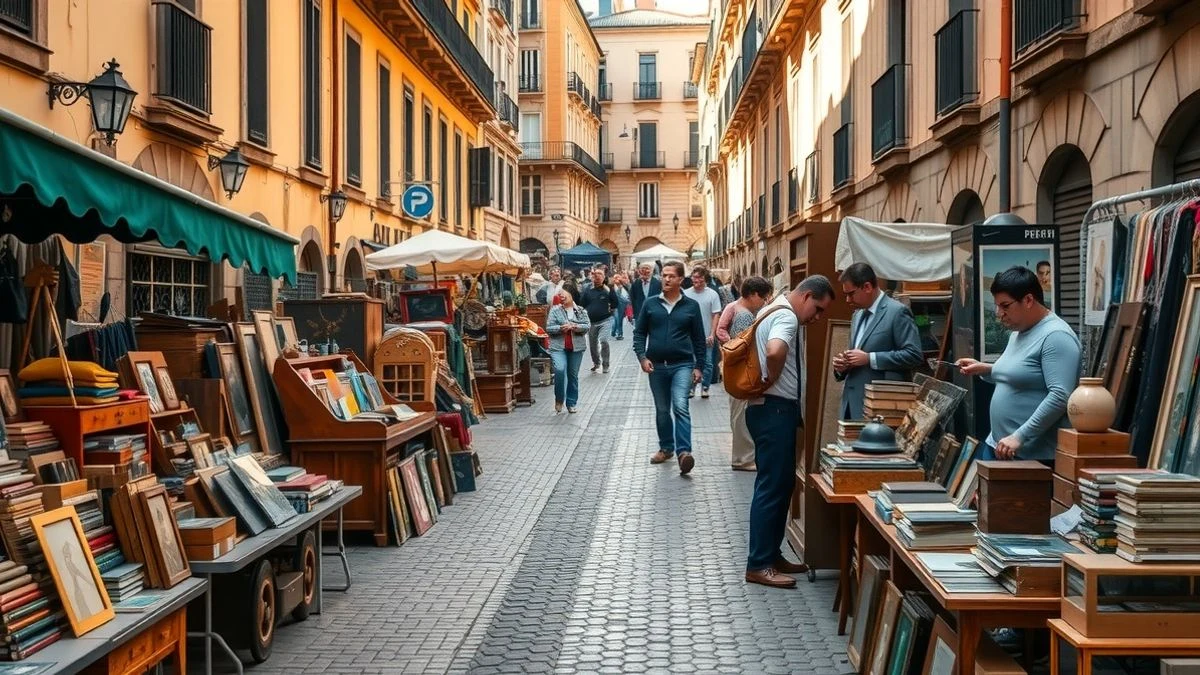
From there, the descent down Ribera de Curtidores offers everything: vintage clothing, tools, antique toys, movie posters, jewellery, shoes, lamps, and even spare parts for appliances. On both sides of the street, outdoor stalls alternate with permanent shops that also open during the week.
San Cayetano street is known as the street of painters. Here, galleries, artists selling their paintings directly to the public, and fine arts supply shops are concentrated. If you have a good eye and some luck, you might take home an original piece at a reasonable price.
The streets Carlos Arniches and Mira el Río Baja are the most nostalgic corner of the Rastro. Shops specialising in antique books, postcards, coins, stamps, comics, vinyl records from all eras, and collectibles ranging from tin toys to typewriters that only the most passionate retro enthusiasts seek are abundant. Meanwhile, Plaza del Campillo del Mundo Nuevo is a hive of people searching for trading cards, letters, and magazines from another era.
Fray Ceferino González street, popularly known as the street of animals, still retains some stalls selling pet accessories and a bird shop with walls lined with cages, a remnant of when the entire street was dedicated to the trade of exotic animals.
The galleries: the more exclusive Rastro
Within the market perimeter, there are two indoor galleries that deserve a specific visit. The Galerías Piquer, at number 29 Ribera de Curtidores, is a small oasis of antiques where you can find everything from art deco furniture to modernist decorative pieces. Legend has it that they were inaugurated with the help of the singer Concha Piquer, after whom they were named.
The Nuevas Galerías, also known as Antigüedades El Jueves, at number 12 of the same street, house some of the best antique dealers in the area. Inside, shops selling silver, cutlery, tableware, collectibles, and decorative pieces ranging from affordable to truly exclusive are lined up.
Practical tips to make the most of it
Arriving early is the first and most important recommendation. Not only because the best items go quickly, but also because from noon onwards the market gets crowded and moving between stalls becomes complicated. The Rastro is for strolling without haste, not for pushing your way through.
Carrying cash is still essential. Many vendors do not have card machines, and at street stalls, cash is practically the only accepted form of payment. Moreover, cash makes haggling easier, which is an inseparable part of the experience. You can and should try to negotiate the price, but always with politeness and a sense of humour: Rastro vendors have been in this business for decades and know perfectly well when someone is playing fair.
Take care of your belongings. With so many people concentrated in a small space, lapses in attention can be costly. Cross-body bags in front, wallets in front pockets, and stay aware of your surroundings.
What to eat in the Rastro and surroundings
The Rastro does not end when the stalls do. A complete visit includes the ritual of food or a snack in one of the historic bars in the area. Bar Santurce, in Plaza del General Vara del Rey, is famous for its grilled sardines eaten standing up. Casa Amadeo, in Plaza de Cascorro, has been serving snails in sauce for decades and is already an institution. And for those who prefer something heartier, the cocido at Malacatín on Calle Ruda has lifelong followers.
If the plan is vermouth with tapas on a terrace, the La Latina neighbourhood offers dozens of options to extend the morning well into the afternoon. The Sunday atmosphere of the neighbourhood, with its cobbled streets and traditional facades, makes the experience hard to beat.
Visiting Madrid's Rastro just once is usually not enough. Each week is different, each stall hides something new, and each visit brings some unexpected surprise. It is one of those places that cannot be fully understood until experienced.
You may also like